






15 Day Tanzania Chimpanzee Safari Rubondo, Gombe & Mahale
The Overview
Why it stands out
Journey Highlights
- Three wild chimpanzee communities in three ecologically distinct forests
- Six nights on Rubondo Island the largest island national park in Africa, with a single camp on it
- Chimpanzee habituation on Rubondo joining the tracking work rather than observing it
- Gombe Stream, where Jane Goodall began her research in 1960 and where it has continued without a break since
- Four nights at Mahale Mountains on the shore of Lake Tanganyika no roads and no vehicles at all
- Tracking the M group in Mahale, habituated since the 1960s by Japanese primatologists
- Swimming, snorkelling and kayaking in Lake Tanganyika, home to several hundred endemic cichlid species
- Boating, birding and catch and release Nile perch fishing on Lake Victoria
The Route
Day by Day
-
Kilimanjaro International Airport → Arusha
Road

ARRIVAL
You are met at Kilimanjaro International Airport and transferred to your lodge in Arusha. This journey moves west in the morning and does not come back until the last day.
EVENING WELCOME BRIEFING
Over dinner your safari consultant walks through the fifteen days, and in particular through the aviation: western Tanzania runs on light aircraft with strict soft bag luggage limits and services that operate on fixed days. Anything surplus stays in Arusha until you return. Your consultant will also explain what the three chimpanzee experiences actually involve, because they are not the same and the expectations for each are different.
Where you'll stay
-
Arusha → Rubondo Airstrip
Flight
routing via Mwanza or the Serengeti depending on the day’s schedule
-
Rubondo Airstrip → camp
Boat
short distance
-
camp → shoreline
Boat
boat trip along the shoreline
MORNING FLIGHT TO LAKE VICTORIA
A scheduled light aircraft flight west across northern Tanzania to Rubondo Airstrip, routing via Mwanza or the Serengeti depending on the day’s schedule. The last part of the approach is over open water and then over an island entirely covered in forest two hundred and forty square kilometres of it, with a single camp on the eastern shore.
AFTERNOON THE SHORELINE
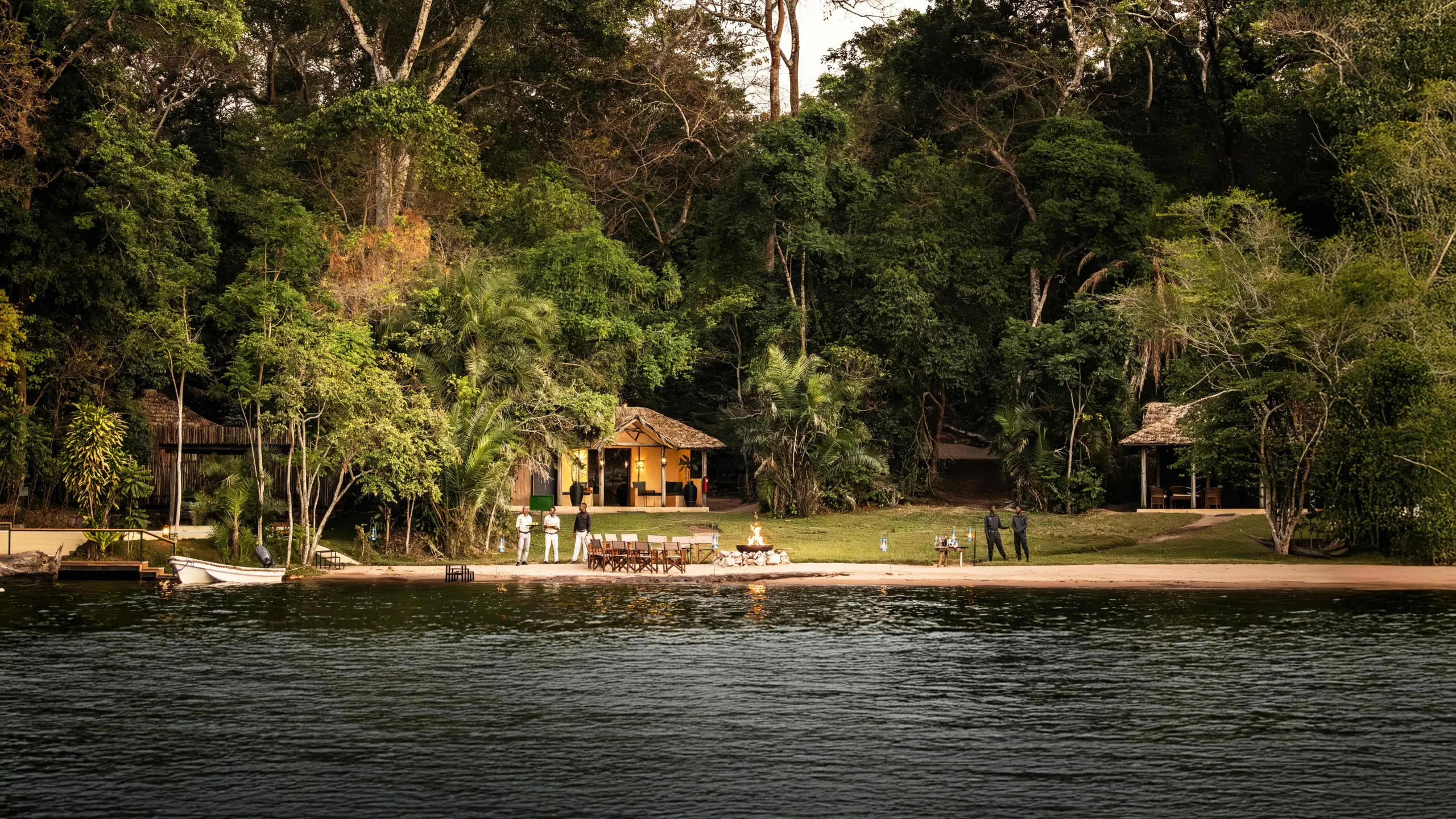
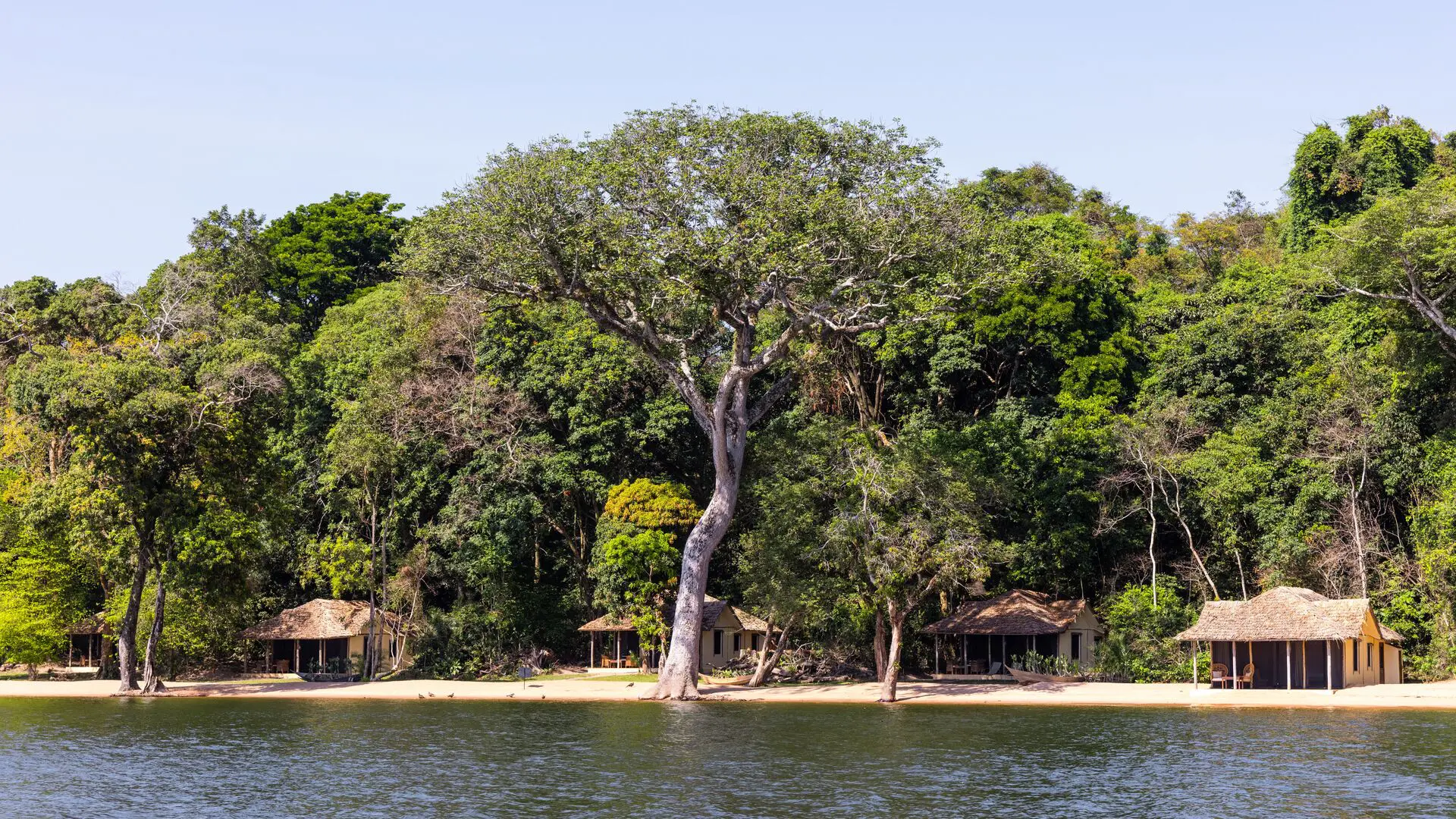
Met at the airstrip and taken the short distance to camp, which sits on a sand beach in a quiet bay. The first afternoon is a boat trip along the shoreline: papyrus beds, fig trees leaning over the water, otter, hippo, and a bird list including fish eagle, malachite kingfisher, papyrus gonolek and, in the right conditions, shoebill.
EVENING
Dinner on the beach. Six nights here.
Where you'll stay
MORNING INTO THE FOREST
Out early with the habituation team. Rubondo’s chimpanzees came from European zoos between 1966 and 1969 and were released here in what was, at the time, an entirely untested experiment. They survived, bred, and now number somewhere around forty. Habituating a forest group that has never been fully accustomed to people is slow and patient work, and guests join it: tracking, listening for pant hoots, reading nest sign, and moving quietly through dense forest.
WHAT TO EXPECT
This is harder and less predictable than trekking a fully habituated group. Some days deliver long sightings, others deliver calls, fresh nests, knuckle prints and no chimpanzee at all. Both are part of the work, and across several consecutive mornings the odds accumulate significantly in your favour.
AFTERNOON
Back to camp and into the lake. Rubondo is warm and humid, and a morning in that forest earns a slow afternoon.
Where you'll stay
MORNING A SECOND MORNING
Out again with the trackers. Continuity is what makes this work: knowing where the group nested last night is how you find them today, and a second consecutive morning is worth considerably more than two separated ones.
AFTERNOON THE FOREST FLOOR
A slower guided walk in the afternoon, looking at what the tracking moves past: butterflies in extraordinary numbers, orchids, chameleons, the sitatunga and bushbuck that use the papyrus edges, and the vervet, black and white colobus and blue monkey in the canopy. Optional: Forest Fly Camping A night in the forest as part of the habituation experience, camped close to where the group has nested so that the next morning begins where they are. Arranged in camp, subject to conditions. USD 400 per person.
Where you'll stay
-
camp → Mlaga Bay
Boat
Take the boat north
MORNING FISHING
Rubondo is one of the best catch and release Nile perch fisheries in Africa and the water around the island holds very large fish. A morning out with the camp boat and guide, working the drop offs and rocky points. Tackle and instruction are provided and no experience is assumed.
AFTERNOON MLAGA BAY
Take the boat north to Mlaga Bay and the papyrus channels, which hold the best birding on the island. Rubondo has recorded well over three hundred species, and the compression of forest, lake and papyrus habitat into a small area is what produces that.
EVENING
Sunset on the water. Lake Victoria is large enough to have a horizon.
Where you'll stay
MORNING INTERIOR FOREST
Rubondo carries an unusual wildlife history. Alongside the chimpanzees, elephant, giraffe, suni and roan antelope were introduced in the 1960s and 70s and several of those populations have thrived in isolation. A morning drive and walk through the interior looks for them; a bull elephant in dense island forest is a genuinely strange sight.
AFTERNOON
Free, or a further tracking session if the group is close. Six nights means the choice is made each morning rather than fixed in advance.
EVENING
Dinner in camp. The forest at night is loud with insects and tree hyrax.
Where you'll stay
MORNING
One more morning with the habituation team, or one more forest trail, or one more boat. Planned at breakfast.
AFTERNOON
An afternoon on the beach and time to repack for the flight south. Luggage limits tighten further on the Kigoma and Mahale sectors.
EVENING
Last night on Lake Victoria. Tomorrow the journey crosses to Tanganyika.
Where you'll stay
-
Rubondo → Mwanza
Flight
scheduled light aircraft
-
Mwanza → Kigoma
Flight
connecting onward
-
Kigoma → Gombe Stream National Park
Boat • around an hour and a half
boat north along the lake shore
MORNING FLIGHT VIA MWANZA
A scheduled light aircraft flight from Rubondo to Mwanza, connecting onward to Kigoma on the shore of Lake Tanganyika. The Mwanza to Kigoma service operates on fixed days of the week, and this journey is built around them; where dates require it, the sector is arranged by charter and confirmed at the time of booking.
AFTERNOON BY BOAT TO GOMBE
From Kigoma, a boat north along the lake shore to Gombe Stream National Park around an hour and a half, hugging a coastline of fishing villages, steep valleys and forested slopes. Gombe is the smallest national park in Tanzania, a narrow strip of mountainside between the escarpment and the water, and there is no road access at all. Arrive at the lodge on the beach in the late afternoon.
EVENING
Dinner by the lake. Tanganyika is deep, cold and startlingly clear, and it looks nothing like Victoria.
Where you'll stay
MORNING TRACKING AT GOMBE
Out with a park guide to find the Kasekela community. This is the group Jane Goodall began observing in 1960, and the research has run continuously ever since, which makes it the longest studied wild animal population in the world. The individuals are named and their lineages documented across generations. The forest is steep and the walking can be hard, but the group is thoroughly habituated and encounters are often close and long.
AFTERNOON KAKOMBE AND THE PEAK
Walk up the Kakombe valley to the waterfall, or climb to Jane’s Peak, the ridge where Goodall sat with binoculars in her first months here and first watched the chimpanzees using tools. Standing on it puts the whole history of the place in order.
EVENING
Back to the beach. Swimming in the lake here is safe and very good.
Where you'll stay
MORNING A SECOND TRACK
A second morning with the chimpanzees. Two consecutive mornings at Gombe is the right amount: the community ranges over a small area, the guides know exactly where they slept, and a second visit lets you watch behaviour rather than simply record a sighting.
AFTERNOON THE OTHER PRIMATES
Gombe’s olive baboon troops have been studied almost as long as its chimpanzees, and they are entirely used to people. Red colobus, red tailed monkey and blue monkey also occur, and the red colobus here are a favoured prey species of the chimpanzees one of the earliest and most significant observations made at Gombe.
EVENING
Sunset over the water with the Congo shore visible on a clear evening.
Where you'll stay
-
Gombe → Kigoma
Boat
boat transfer back along the shore
-
Kigoma → Mahale
Flight
by light aircraft to the park airstrip
-
Mahale Airstrip → camp
Boat
boat along the shore to camp
MORNING BACK TO KIGOMA
A boat transfer back along the shore to Kigoma. There is time to see something of the town the old railway terminus at the end of the line from Dar es Salaam, and Ujiji just to the south, where Stanley is said to have found Livingstone in 1871.
AFTERNOON TO MAHALE
Continue south to Mahale by light aircraft to the park airstrip, followed by a boat along the shore to camp; where the schedule dictates, the sector runs by charter and is confirmed at booking. The final approach is by water, with the forested mountains rising straight out of the lake and the water clear enough to see the bottom well offshore. There are no roads in Mahale at all.
EVENING
Arrive at camp on a white sand beach. Four nights here, and no vehicle for any of them.
Where you'll stay
MORNING INTO THE MOUNTAINS
After breakfast, out with a park guide and trackers to find the M group habituated over decades of continuous research beginning with Japanese primatologists in the 1960s, and the largest of the three communities on this journey. The trackers go ahead at first light. When the group is located, you climb. The forest is steep, hot and dense, and the walk in can take anything from twenty minutes to several hours.
THE HOUR
Time with the chimpanzees is limited to one hour by park regulation and masks are worn to protect the group from human respiratory infection. What happens in that hour is not predictable: the group may be feeding high in the canopy, or moving past you on the ground at a few metres, grooming, arguing, and behaving in ways that are uncomfortably familiar.
AFTERNOON
Back to camp and straight into the lake. The afternoon is entirely free, which after that climb is not a luxury.
Where you'll stay
-
camp → along the shore
Boat
Take a dhow along the shore
MORNING A SECOND TRACK
A second track with the M group. Two mornings are considerably better than one: the group moves, the forest is large, and a second attempt both improves the odds and takes you into a different part of the community’s range. Permits and park fees for both mornings are included.
AFTERNOON THE SHORE
The afternoon belongs to the lake. Take a dhow along the shore, snorkel the rocky sections for the endemic cichlids that make Tanganyika one of the most important freshwater ecosystems in the world, fish for the lake’s yellow belly, or simply swim. There is no other camp in sight.
EVENING
Sunset over the water with the Congo somewhere beyond it.
Where you'll stay
MORNING
The last full day, and it is yours. Track a third time if you want to. Walk a forest trail for the red colobus, blue and red tailed monkeys and the birding. Climb towards the Kungwe ridge for the view down the length of the lake. Or do none of it.
AFTERNOON
Kayaking, swimming, a boat out for the sunset. Three forests and two lakes in fourteen days is a great deal of movement, and Mahale is the right place to stop moving.
EVENING
Final dinner on the beach. Three chimpanzee communities, each with a different history, each in a forest that produced a different kind of animal.
Where you'll stay
-
camp → Mahale Airstrip
Boat
boat transfer along the shore
-
Mahale Airstrip → Arusha
Flight
scheduled light aircraft flight east, routing via Katavi or an intermediate airstrip according to the day’s schedule
MORNING
A boat transfer along the shore to Mahale Airstrip and a scheduled light aircraft flight east to Arusha, routing via Katavi or an intermediate airstrip according to the day’s schedule, for your onward international connection. Timings are confirmed before departure. Fifteen days in western Tanzania without a single game drive, and a stronger case than most safaris make for why any of it matters.
Before You Book
Important Information
Accommodation
Hotels, lodges and camps named in this package are subject to availability when your booking is confirmed. If a listed property is unavailable, we will propose a comparable alternative for your approval.
Investment
Included
- All ground transportation, airport transfers and boat transfers throughout Tanzania
- Boat transfers Kigoma to Gombe return, and Mahale Airstrip to camp return
- All park entry fees Rubondo Island, Gombe Stream and Mahale Mountains National Parks
- Chimpanzee habituation activities and permits on Rubondo Island
- Two chimpanzee tracking permits and park guide fees at Gombe Stream
- Two chimpanzee tracking permits and park guide fees at Mahale Mountains
- Boating, kayaking, snorkelling and catch and release fishing as offered by each camp
- Guided forest walks at Rubondo, Gombe and Mahale
- Full board meals throughout the journey, and camp house drinks where the property includes them
- Resident camp and park guiding throughout
- All accommodation as listed
- All applicable government taxes
Excluded
- International flights
- Scheduled light aircraft flights Arusha to Rubondo, Rubondo to Kigoma via Mwanza, Kigoma to Mahale and Mahale to Arusha quoted separately above
- Travel insurance strongly recommended, and required to include emergency evacuation cover for western Tanzania
- Visa and passport fees
- Tips for guides, trackers and camp staff
- Alcoholic beverages beyond those included by the camp
- Personal items
- Optional forest fly camping night on Rubondo
- Private charter costs where dates fall outside the scheduled western flight days
- Park fee increases beyond our control
Start Planning
Book this Journey
Secure your dates or begin customizing this itinerary to perfectly fit your preferences.
No commitment required.
Continue Exploring
Similar Journeys
10 Day Luxury Tanzania Safari Serengeti & Ngorongoro Crater
From US$6,450
per person sharing
Destinations
Ngorongoro Crater & Serengeti National Park
15 Day Tanzania Safari Serengeti & Rubondo Island Chimpanzees
From US$9,300
per person sharing
Destinations
Serengeti National Park & Zanzibar
17 Day Tanzania Safari Serengeti, Ngorongoro & Private Island
From US$10,500
per person sharing
Destinations
Ngorongoro Crater, Serengeti National Park & Zanzibar
12 Day Southern Tanzania Safari Ruaha & Nyerere (Selous)
From US$5,900
per person sharing
Destinations
Nyerere National Park & Ruaha National Park
15 Day Tanzania Chimpanzee Safari Rubondo, Gombe & Mahale
15 Days