




Where, when and how.
Not an event with a date, but a continuous circuit and Tanzania holds the majority of it.
A circuit, not an event
The thing to understand first
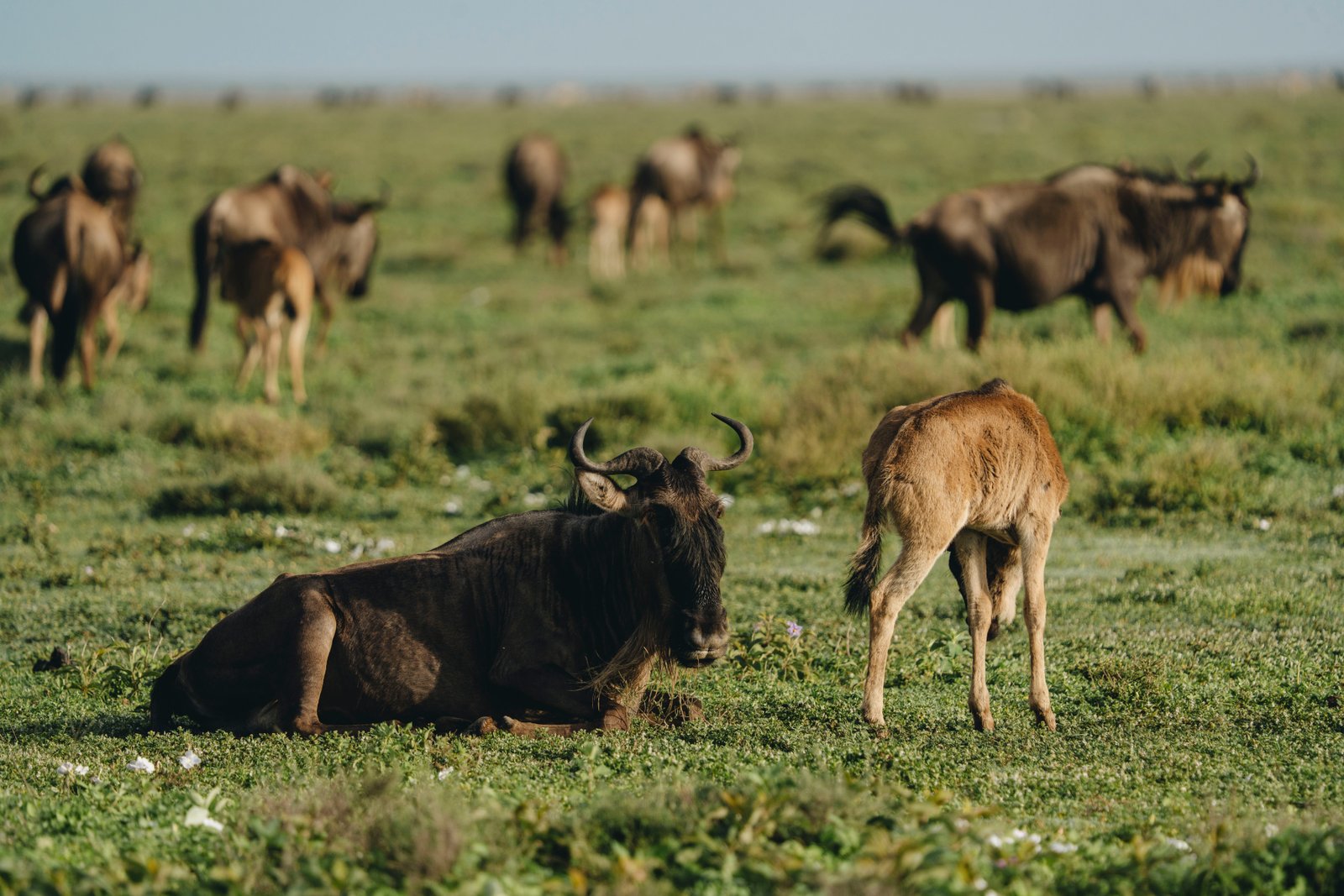
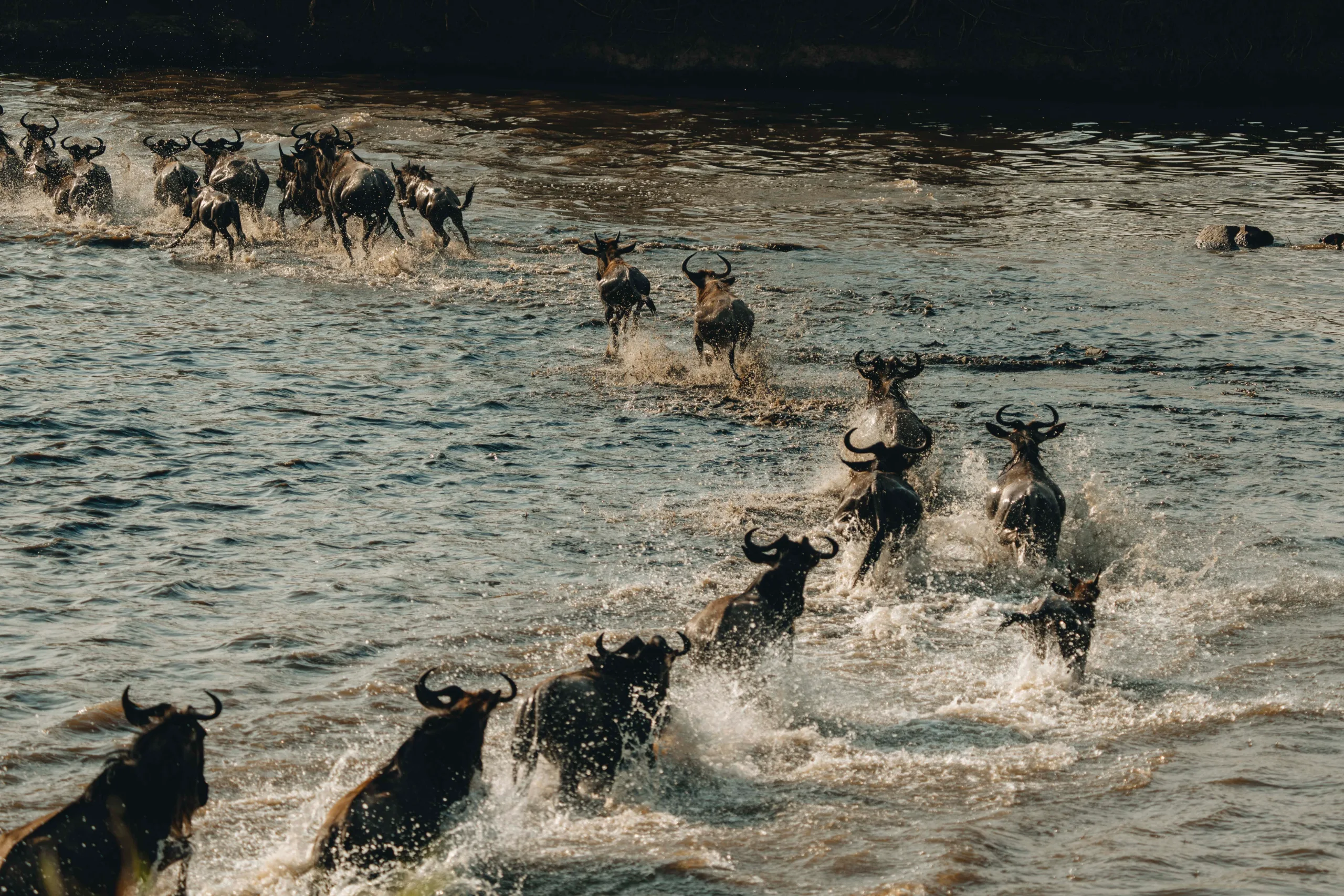
The Great Migration is a continuous, year round movement of around 1.5 million wildebeest and several hundred thousand zebra and gazelle around the Serengeti Mara ecosystem.
Almost every mistake travellers make about the migration follows from thinking of it as a fixed spectacle, in one place, at one time of year.
The herds are somewhere in the Serengeti in every month. The question is therefore not whether you can see the migration, but which chapter of it you want to see, and where to position yourself for that chapter.
- 1.5m wildebeest on the move
- 1,600km covered each year
- 8,000 calves born daily at peak
- 200,000 lost each cycle
Alongside the wildebeest travel around 200,000 zebra and 300,000 Thomson's gazelle. What these figures describe is not a migration in the sense of a journey from one place to another. It is a loop with no beginning and no end, driven by rainfall and the quality of the grazing it produces, repeating itself indefinitely.
Roughly half a million calves are born across a single season, the great majority within a window of about three weeks. Around 200,000 animals are lost each cycle to exhaustion, drowning and predation. Both numbers describe the same system working as it should.
What follows sets out the full cycle, the regions that matter in each season, an honest account of what can and cannot be promised at a river crossing, and how to shape a migration safari around whichever chapter you choose.
One year, four chapters
Rainfall drives the movement, so every date below is a tendency rather than a schedule. The herds can arrive weeks early or weeks late, and they routinely double back.
January March: Calving
The short grass plains of Ndutu and the southern Serengeti, where volcanic soils produce grass rich in the minerals a lactating female needs.
Calving is remarkably synchronised: the strategy is one of overwhelming numbers, so many calves arriving at once that predators cannot take a meaningful proportion.
Best for predator behaviour, photography, fewer vehicles.
April June: North, and the rut
The long rains trigger movement north west. The herds string out in long columns across the central Serengeti and the rutting season begins.
By late May and June the leading herds reach the western corridor and the Grumeti River smaller crossings than the Mara, less predictable, far fewer vehicles.
Best for green landscapes, value, quiet.
July October: The Mara River
The most famous chapter, in the northern Serengeti, where the river lies between the herds and the grazing beyond it.
Crossings take place over months at multiple points, sometimes several times a day and sometimes not for days. Herds also cross back and forth normal behaviour, not a failed migration.
Best for drama, scale, first time migration travellers.
November December: The return south
The short rains draw the herds back down through the eastern and central Serengeti toward the calving grounds, crossing the Mara once more on the way.
By late December the leading herds are usually approaching the southern plains, where the cycle begins again.
Best for green season value, movement without crowds.
The seasonal pattern can be summarised as:
- Jan Mar: Ndutu and southern Serengeti calving, intense predator activity, open plains; moderate vehicle numbers.
- Apr Jun: Central and western Serengeti long columns, rutting, possible Grumeti crossings; low vehicle numbers.
- Jul Oct: Northern Serengeti Mara River crossings, massed herds; high vehicle numbers.
- Nov Dec: Eastern and central Serengeti herds moving south, green landscapes; low to moderate vehicle numbers.
An honest word about river crossings
Said plainly, and in writing
No operator can guarantee that you will witness a river crossing on a particular day and you should be sceptical of any who imply otherwise.
The herds decide. They may gather on a bank for hours and disperse. They may cross at first light before vehicles arrive, or at a point twenty minutes' drive from where you are waiting.
We have had guests see three crossings in four days, and guests who spent four days in prime position during peak season and saw none. Both trips were sold in exactly the same way, by the same people, with the same care.
What you can reasonably expect in the northern Serengeti between late July and September is this: very large concentrations of wildebeest and zebra, crocodile in the river, predators working the margins, and a realistic chance of a crossing over a stay of three or more nights. That is a genuinely exceptional safari with or without the crossing itself.
We say this before you book rather than after, because a traveller who arrives with accurate expectations has a better trip than one who arrives expecting a documentary sequence to be delivered on schedule.
Two planning principles that follow
- Position beats dates. Being in the northern Serengeti in August is what gives you a chance at a crossing; being in the central Serengeti that month does not, however good the general wildlife there is.
- Give yourself nights, not days. Three nights in the right region means three full days to work with. Two nights, one consumed by travel, often means one real chance.
Calving or crossings?
Most travellers are deciding between the two headline seasons. Here is how we frame the choice.
Late January February: Choose calving season if…
You care most about predator behaviour and photography. You want fewer vehicles. You are travelling with children who will engage more with newborn animals than with a long wait on a riverbank. Or you want strong value in a high quality season.
The calving season chapter
Late July September: Choose the crossings if…
The river crossing is specifically what you have come for, and you can accept that it may not happen. You are travelling in the northern hemisphere summer. And you can book early enough to secure the right camps in the north.
The river crossings chapter
June, or November: The overlooked answer
The herds without the peak season pricing and pressure. Green landscapes, low vehicle numbers, and genuine migration movement. If your dates are fixed outside the two headline windows, these months are considerably better than their reputation.
Worth saying: There is no wrong answer
We have had guests return for the opposite season having done one of them, which is probably the most useful recommendation in this journal. The two chapters are different experiences rather than better and worse ones.
How to structure a migration safari
A migration safari is not only the Serengeti. The strongest itineraries pair time with the herds against contrasting country.
Six to nine days the working lengths
- 6 Tage Great Migration Safari 6 days Ngorongoro and a focused Serengeti stay.
- Serengeti River Crossing Safari: Großes Migrationsspezial 8 days The comfortable crossing season length.
- 8 Tage River Crossing & Tanzania Wildlife Safari 8 days Crossings with Tarangire added.
- 9 Tage Great Migration Safari 9 days Scheduled group departure.
Ten days and beyond, or short and focused
- Serengeti River Crossing Safari und Zanzibar Beach Escape 11 days Migration then the Indian Ocean.
- Great Migration Family Safari und Zanzibar Beach Retreat 12 days The same shape, paced for children.
- 5 Tage am Fluss Mara 5 days Staying put in the north, minimal transit.
- 3 Tage Zanzibar nach Northern Serengeti Fliegen in Safari 3 days A migration stay attached to a beach holiday.
Every one of these is a starting point rather than a fixed product, which is the whole point of planning a journey with us.
Where to stay, and why it matters more here
Accommodation choice matters more on a migration safari than on any other kind, because location determines your drive time to the herds.
Follows the herds: Mobile tented camps
These relocate two or three times a year Ndutu in calving season, the north for the crossings. Comfortable rather than opulent, and their advantage is simple: you wake up where the animals are. For many travellers this is the correct choice regardless of budget.
Fixed position: Permanent camps and lodges
More infrastructure, larger rooms, pools and spas. Excellent properties but a fixed location in the central Serengeti is a long drive from the Mara River in August, and no amount of comfort closes that distance.
Concessions: Private and ultra luxury
In the Grumeti and northern concessions: exclusivity, off road access in some areas, and night drives where permitted.
The real constraint: Lead time
The best placed camps in the northern Serengeti for August, and on the Ndutu plains for February, are frequently sold out a year ahead. If your dates are fixed, start early it is the single most useful thing you can do for the quality of your trip.
Making more of the migration
A few additions consistently improve a migration safari.
- Hot air balloon safaris are at their most extraordinary over massed herds, giving the aerial scale ground level cannot.
- Photographic safaris with earlier departures and longer sittings which matters enormously at a crossing, where patience is the whole game.
- A private vehicle, in any season. It determines when you leave, how long you stay, and whether you wait out a gathering herd for three hours.
- Combining regions: the Ngorongoro Crater before or after the Serengeti gives you density and black rhino alongside the migration's scale.
Frequently asked
Where is the migration right now?
It depends on the season and on recent rainfall. Broadly: Ndutu and the southern Serengeti from January to March, central and western from April to June, the northern Serengeti from July to October, and moving south in November and December. We track herd movement through our guides on the ground.
When is the best time to see it?
Late July to September for the Mara River crossings; late January to February for calving on the southern plains. Both are exceptional, and they offer different experiences.
Can you see it all year round?
Yes, in Tanzania. The herds remain within the Serengeti ecosystem throughout the year. What changes is their location and the nature of what you see.
Are river crossings guaranteed?
No. Crossings depend on the herds' behaviour and cannot be predicted for a specific day. Three or more nights in the northern Serengeti between late July and September gives you a realistic chance, but no operator can guarantee it.
Tanzania or Kenya?
Both offer genuine migration experiences. Tanzania holds the larger share of the ecosystem and hosts the herds for most of the year, including calving, which does not occur in Kenya. Kenya's Maasai Mara offers crossings over a shorter seasonal window.
How many days do you need?
Six at minimum, with at least three nights positioned in the region where the herds are. Eight to nine is the comfortable length and allows a second destination such as the Ngorongoro Crater.
How much does it cost?
Cost depends on season, camp category and whether you fly or drive between regions. Peak crossing season in the north is the most expensive period of the year; calving and green season travel cost meaningfully less for comparable quality.
Wie weit im Voraus sollte ich buchen?
For July to September in the northern Serengeti, and February at Ndutu, eight to twelve months is realistic if you want the well positioned camps. Other periods allow shorter lead times.
The herds have been doing this rather longer than we have been watching.
They will do it again next year whether or not we are positioned correctly for it. Our job is to make sure you are: in the right region rather than the convenient one, in camps chosen by position as well as comfort, with enough nights to let the animals work to their own timetable rather than yours.